
Practical, compassionate guidance for families who want to help a loved one with addiction while caring for themselves too.
6 MIN READ • THE PREHAB RECOVERY LIBRARY

When someone you love is struggling with addiction, helping can become unexpectedly complicated.
It often begins with something that feels entirely reasonable. You lend money because the rent is due. You call an employer because another absence could cost them their job. You collect them late at night because leaving them where they are feels unsafe. You cover a debt, make another excuse, or take over a responsibility they have stopped managing.
Most families are not trying to protect an addiction. They are trying to protect a person they love, preserve the household or reduce harm. But over time, the family can become responsible for managing more and more of the consequences. The immediate crisis is contained, yet the underlying problem remains.
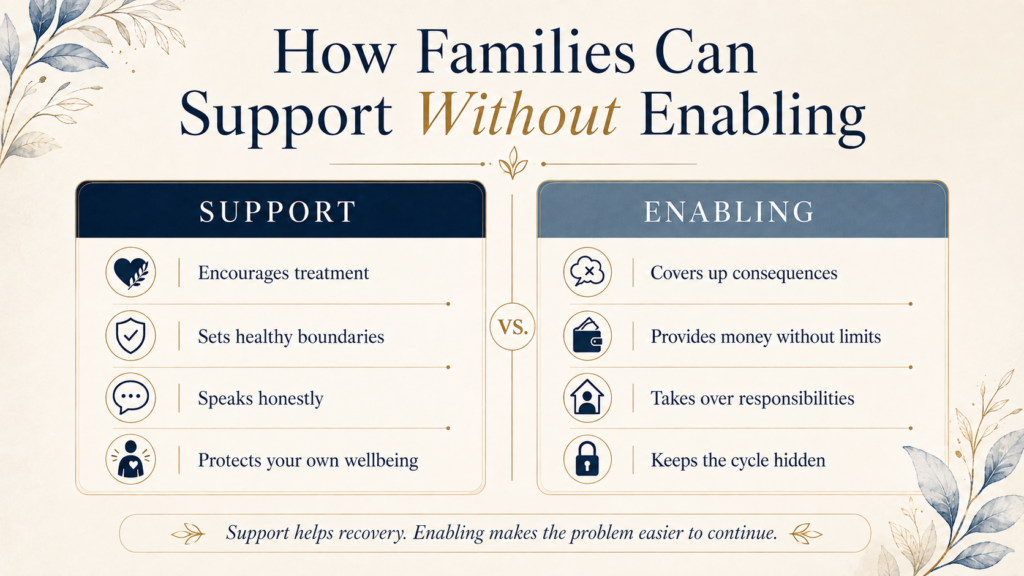
This is where the distinction between support and enabling matters. The answer is not to become cold, withdraw all help, or wait for someone to “hit rock bottom”. The task is more humane: to help in ways that make recovery, honesty and responsibility easier, without making the addiction easier to continue.
The word enabling is often used as though it describes a failure by the family. That is rarely useful. Most enabling develops gradually, often out of fear.
A practical way to understand it is this: support helps a person move towards safety, responsibility and recovery; enabling repeatedly protects them from the effects of the problem in ways that allow the pattern to continue more easily.
Paying for treatment may be supportive. Repeatedly paying debts caused by drinking, drugs or gambling may keep the cycle going. Driving someone to an assessment may be supportive. Calling their employer again and again to explain absences may prevent them from confronting what their substance use is doing to their life.
| “Is what I’m doing helping them move towards change, or helping them avoid it?” |
Addiction rarely stays contained within one person. As life becomes more unpredictable, families become more vigilant. Someone watches the finances. Someone checks whether the person has been drinking. Plans change according to their condition. Children learn when not to ask questions. One person keeps the peace while another handles the practical fallout.
Families adapt because they have to. The difficulty is that temporary adaptations can become permanent roles. Before long, the household is organised around preventing the next crisis.
This may reduce immediate disruption, but it can also mean that other people are carrying much of the impact. Recognising this is not about blame. It is about seeing the pattern clearly enough to change it.
Supporting a loved one with addiction does not mean standing back. You might research treatment options together, sit beside someone while they make the first call, provide transport to an assessment, or help with treatment costs if appropriate.
At the same time, you may decide that you will no longer provide unrestricted cash, repeatedly clear debts, lie to other people, explain away absences, or repair every consequence of the addiction.
The principle is simple, even when practising it is not: help with recovery; be cautious about helping with the continuation of the problem.
Families are often told to “set boundaries”, but boundaries can easily become disguised demands.
“You must stop drinking” or “You have to go to rehab” may express what you desperately want, but they depend on another person’s behaviour. A boundary describes what you will do, provide, accept or participate in.
| “I won’t give you cash, but I am willing to pay the treatment provider directly.” |
| “I won’t continue this conversation while you are intoxicated. We can speak tomorrow.” |
| “I will help you look at treatment options, but I won’t keep calling your employer to explain your absences.” |
This is often the hardest part. If you do not pay the bill, what happens? If you stop covering for them at work, could they lose their job? If you refuse to lend more money, will things become worse?
There are no universal answers. Safety, children, housing, finances and medical risk all matter. But allowing a consequence is not the same as punishment.
Sometimes a person needs to make the uncomfortable phone call themselves. They may need to explain an absence, address a debt, apologise directly, or face the fact that trust has changed.
When every consequence is removed, the seriousness of the problem can remain easier to minimise. You do not have to manufacture a “rock bottom”. You also do not have to make every consequence disappear.
Safety comes first. Suspected overdose, severe withdrawal, suicidal behaviour, violence, psychosis or another medical or psychiatric emergency requires an immediate safety response. Boundaries are not a substitute for urgent clinical care.
Addiction creates uncertainty, and uncertainty makes people search for reassurance.
You may begin checking bank transactions, smelling someone’s breath, monitoring medication or analysing every change in mood. Some monitoring may be necessary where there are genuine safety concerns, children involved or agreed treatment arrangements.
But constant surveillance can consume your attention without providing the certainty you are looking for. It can also make you feel responsible for detecting and preventing every relapse.
Ask yourself: “Is there a specific safety issue that requires action, or am I trying to make an unpredictable situation feel predictable?”
By the time families speak openly about addiction, there may already be years of frustration behind the conversation. It is easy for that frustration to become a judgement about the person.
“You are selfish.” “You do not care about us.” “You are ruining everything.”
The hurt may be real, but these statements often lead to arguments about character rather than a conversation about what is happening.
Try to stay closer to what you can observe: “You have missed work several times after drinking.” “We keep having the same arguments about money, and I am worried.” “The atmosphere at home changes when you are using.” “I think we need some outside help.”
You do not have to minimise reality in order to speak respectfully. The aim is not to win an argument or force an admission. It is to make honesty more possible.
When addiction becomes serious, every interaction can begin to feel like an investigation: Did you drink? Where were you? Are you telling me the truth?
Some of these questions may be necessary. But if every conversation becomes about the problem, the relationship itself can begin to disappear.
Where it is safe, preserve some ordinary contact. Eat together. Talk about work, family, music, a film, the dog, the garden — anything that reminds both of you that life is larger than the addiction. This is not denial. It is remembering that the person you love is still a person, not a problem to be managed.
One of the most common traps for families is postponing their own life until the person gets better. You will sleep properly when they stop drinking. You will see friends again when things settle down. You will look after yourself when the crisis is over.
But addiction can keep a family waiting for a very long time.
Your wellbeing cannot depend entirely on whether another person is sober, attending treatment, telling the truth or making good decisions. Looking after yourself may mean therapy, a family support programme, protecting your finances, reconnecting with people you trust, restoring sleep and routine, or becoming clearer about behaviour you will no longer accept.
Their recovery and your wellbeing are connected, but they are not the same thing.
Families often fear that setting limits will make them seem unloving. But love does not require you to absorb every consequence or keep rescuing someone from the same situation.
You can understand why someone is struggling without pretending harmful behaviour is acceptable. You can offer treatment without taking responsibility for whether they accept it. You can remain emotionally available while becoming more careful about money. You can support recovery without trying to manage it.
There will still be uncertainty. You may revise a boundary or step in during a genuine crisis. Families living with addiction do not need to respond perfectly.
What matters is the direction: away from secrecy, rescuing and constant crisis management, and towards greater honesty, responsibility, safety and connection.
Sometimes the first meaningful change does not begin with the person using substances. Sometimes it begins when the family changes how it responds.
Every family situation is different. What is appropriate depends on the severity of the addiction, physical and mental health risks, children, finances, relationships, previous treatment attempts and the person’s willingness to accept help.
If you are unsure whether you are supporting, rescuing or enabling, you do not have to work it out alone.
The Prehab offers confidential online family support and guidance to help families understand what is happening, identify healthier boundaries, communicate more effectively and think through what kind of support is appropriate for their loved one and for themselves.
You do not need to have everything figured out before reaching out.