Approx. 6-minute read • The Prehab
When someone is struggling with alcohol, drugs, compulsive behaviour, anxiety, depression or another mental health difficulty, the conversation often moves surprisingly quickly towards a solution.
Sometimes the problem is minimised. They are still working, still functioning, still getting through the day. Perhaps they simply need to be more disciplined, drink less, sleep better or pull themselves together. At other times, the opposite happens: the situation is labelled serious and the answer becomes obvious — treatment, rehab, time away, something intensive.
Either response may occasionally be right. But both can begin in the wrong place. Before asking “What treatment should this person have?”, there is a more fundamental question: What is actually happening here, and what kind of help is sufficient for it?
There is a large and important space between doing nothing and entering residential treatment. It can include assessment, brief intervention, specialist counselling, psychotherapy, medical or psychiatric care, medication, family work, peer support, structured outpatient programmes, recovery support and, when necessary, residential or hospital-based care. These are not simply weaker and stronger versions of the same thing. They serve different purposes.
| The task is to understand what kind of support fits this person, at this point, with these risks, resources and circumstances. |
Consider someone whose drinking has gradually increased over the past year. There are more arguments at home. Sleep is poor. Mondays are becoming difficult. They sometimes decide to stop for a few weeks but find themselves drinking again within days.
They are still going to work. There has been no dramatic crisis. They do not identify with the word “alcoholic”, and the suggestion of residential rehab seems completely disproportionate. Perhaps they need residential treatment. But perhaps they do not.
A more useful first step may be a careful assessment with someone who understands addiction well enough to explore what is happening without forcing an identity or predetermined solution. How much control has actually been lost? What function is alcohol serving? Are tolerance or withdrawal developing? Is anxiety contributing to the drinking, or increasingly being worsened by it? What happens when the person genuinely tries to stop? What has the family begun changing or accommodating around the problem? What are the likely consequences if the pattern continues?
There is another important question: what is the person currently capable of engaging with? This does not mean treatment should simply follow preference regardless of risk. Safety can override convenience. But outside acute situations, treatment works through human participation. A theoretically perfect recommendation has limited value if the person cannot meaningfully engage with it.
Current addiction-care frameworks reflect this principle. The ASAM Criteria uses multidimensional, person-centred assessment to help determine an appropriate level of care, with reassessment as needs change.¹ Good assessment should therefore produce more than a label. It should produce a direction.
Not everybody who is developing a problem has reached the point of needing an intensive programme. For someone drinking at risky levels, for example, screening and brief intervention can help create awareness, strengthen motivation and begin a practical plan for change. Current NIAAA guidance supports brief intervention for heavy drinking while recognising that it will not be sufficient on its own for everyone with more substantial alcohol use disorder.²
That distinction matters. Early intervention is not the same as pretending a problem is minor. It is recognising that people do not need to deteriorate before something useful can happen.
For another person, the right starting point may be regular specialist counselling or psychotherapy. The work may involve emotional regulation, trauma, relationships, shame, anxiety, depression or the quiet negotiations that allow an addictive pattern to continue: only at weekends; never before six; this week has been stressful; I can stop whenever I decide to.
There is nothing “light” about good psychotherapy simply because it takes place once or twice a week. The question is whether it is enough. If someone remains medically and psychiatrically stable, lives in a reasonably safe environment, can function between sessions and is capable of using what happens in therapy, outpatient work may be entirely appropriate. For some people, it will not be.
There is an equally important mistake at the other end of the spectrum: assuming that every psychological difficulty can be solved through conversation alone. Some people require psychiatric assessment, medication, medical investigation or addiction-medicine input alongside psychotherapy. Evidence-based medications have an established role in treating some substance use disorders, including alcohol and opioid use disorders, and may be combined with behavioural and recovery-oriented care.³
Co-occurring mental health conditions can also change what good treatment looks like. Significant depression, bipolar disorder, psychosis, severe anxiety, trauma-related difficulties or other psychiatric problems may require coordinated care rather than one practitioner trying to hold every part of the problem. Part of competent therapy is recognising when somebody else needs to be brought into the picture.
There is considerable territory between weekly therapy and residential treatment. Intensive outpatient and partial-hospitalisation programmes can provide more frequent individual or group work, skills development, monitoring and coordination while allowing someone to continue living outside a residential facility. SAMHSA describes these as more intensive forms of coordinated care than standard outpatient appointments.⁴
For the right person, this middle ground can be particularly useful. Recovery is being practised while ordinary life is still happening — relationships, work, evenings, loneliness, stress and access to old coping strategies have not disappeared. For someone else, that very environment may be the reason outpatient treatment is not enough.
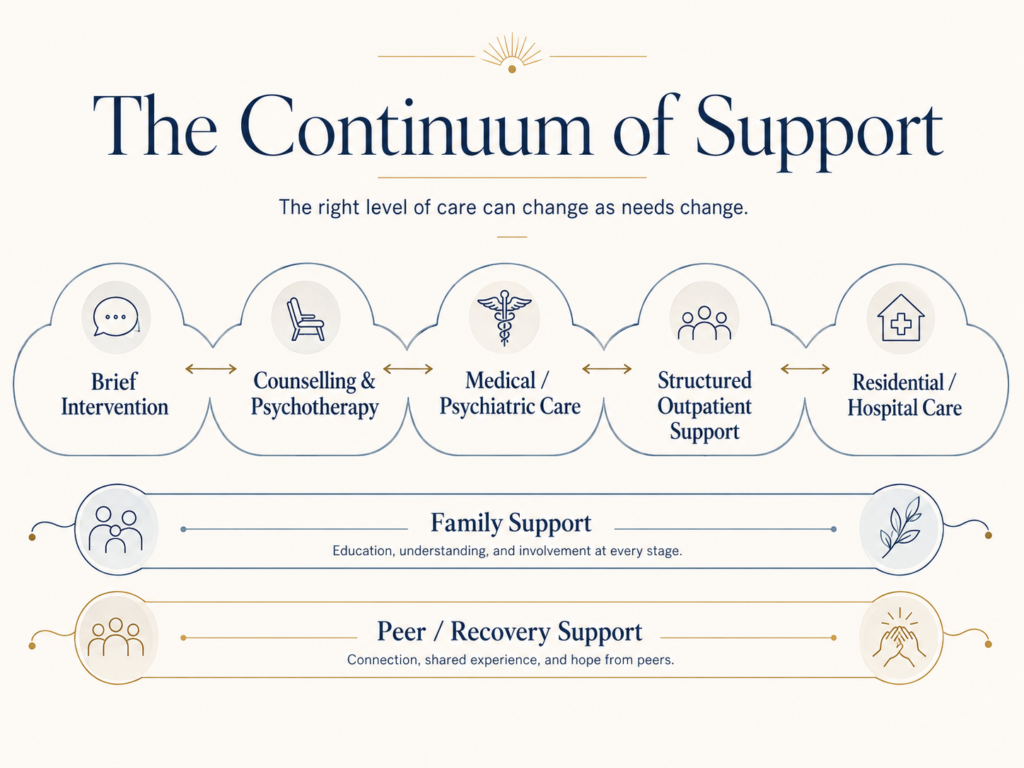
Support does not always follow a fixed sequence. Different forms of care can overlap, and the appropriate level can change as needs change.
There are circumstances in which a person needs greater containment, intensity and protection than outpatient treatment can reasonably provide. They may repeatedly be unable to interrupt substance use despite serious consequences. Their living environment may be unsafe or saturated with substances. Previous attempts at lower-intensity care may have repeatedly broken down. Medical or psychiatric concerns may be significant. The person may need sustained structure, multidisciplinary treatment and a period away from conditions in which the problem has become deeply established.
Residential treatment can provide something ordinary weekly therapy cannot: a therapeutic environment organised around recovery. When that is genuinely needed, recommending something less intensive simply because it feels easier or less disruptive is not person-centred care. But the reverse is also true. Residential treatment should not become the default simply because it is the largest intervention available.
| Intensity and appropriateness are not the same thing. |
This distinction becomes particularly important when physical dependence is present. Some forms of withdrawal can be medically dangerous. Alcohol withdrawal, for example, may require supervised management depending on a person’s pattern of use, previous withdrawal history, medical condition, psychiatric risks and environment. Abruptly stopping benzodiazepines after physical dependence has developed can also carry serious risks and requires appropriate clinical guidance.
But safely getting through withdrawal is not the same as treating everything that led to the problem. ASAM explicitly describes alcohol withdrawal management as a component of initiating and engaging someone in ongoing treatment rather than an effective treatment for alcohol use disorder on its own.⁵ A person can therefore leave withdrawal management physically substance-free while the psychological, relational and behavioural machinery of the addiction remains largely untouched.
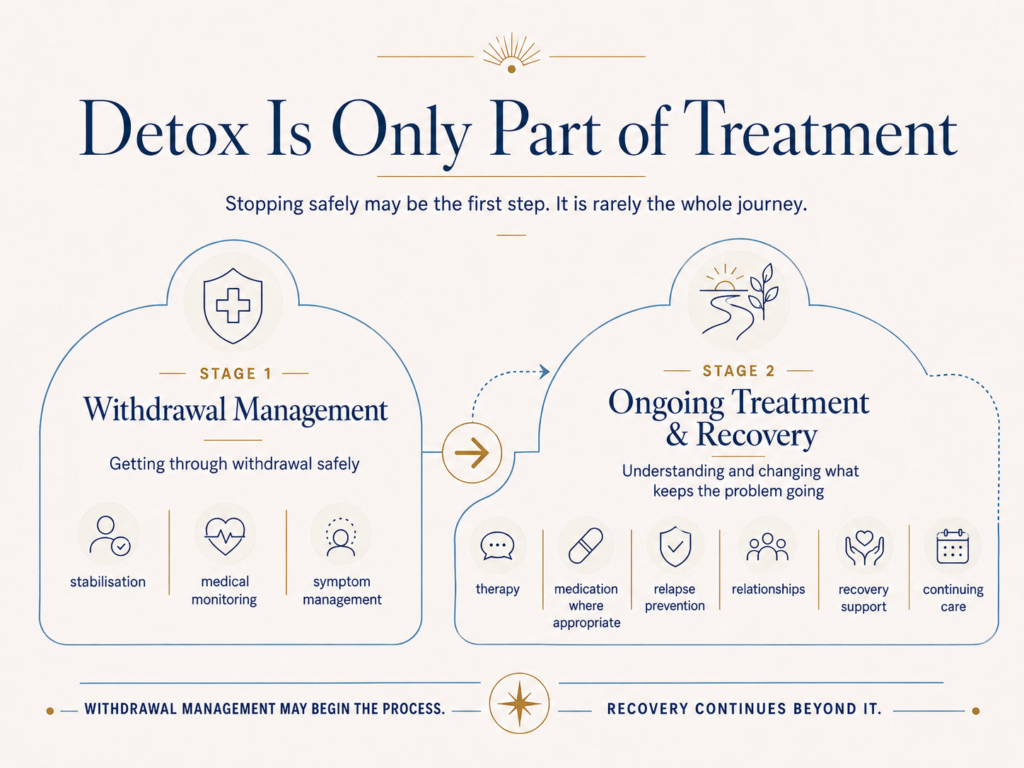
When withdrawal management is needed, it may begin the process. Ongoing treatment addresses the longer work of change and recovery.
There is another assumption worth challenging: that help can begin only once the person with the problem agrees to receive it. Families often seek support first.
They may need help understanding what they are seeing, communicating more clearly, establishing boundaries, responding to crises, reducing patterns that unintentionally shield someone from consequences, and deciding what they themselves can reasonably continue to carry. NICE guidance for alcohol-use disorders also recognises support for families and carers as part of good-quality care.⁶
Years of monitoring moods, checking finances, searching for bottles, managing explanations, absorbing anger or waiting for the next crisis can reorganise an entire household around one person’s difficulty. The family does not have to postpone all support until that person becomes ready.
Professional treatment and peer support are different forms of help. Mutual-aid groups, recovery communities and trained peer workers can provide identification, belonging, accountability and contact with people who know recovery from lived experience. For many people, that becomes an important part of maintaining change.
It does not have to replace professional treatment, and professional treatment does not make it redundant. The strongest recovery structure may contain several kinds of support doing different jobs. This is another reason the question “Which treatment is best?” can be misleading. There may not be one.
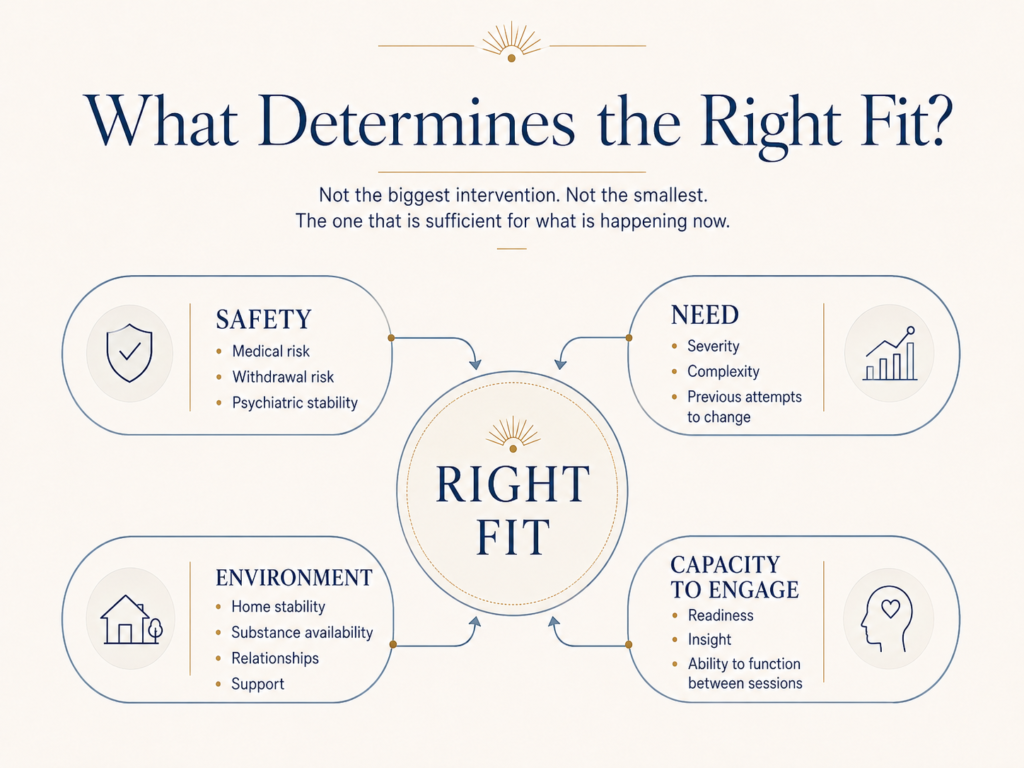
These factors guide clinical thinking; they are not a formula or a self-assessment tool.
Perhaps the most useful way to think about treatment is not as a destination but as something responsive. Someone may begin with an assessment and several focused sessions, and that may prove sufficient. Another person may begin similarly and gradually reveal a level of dependence, psychiatric difficulty or instability that requires considerably more support.
Someone returning from residential treatment may initially need intensive continuing care before gradually reducing the frequency of professional support as recovery becomes more established. Good care should be capable of changing its mind. That is not treatment failure. It is treatment responding to new information.
The question becomes less about finding the perfect programme and more about asking whether the current support remains safe enough, substantial enough and useful enough for what is happening now.
People often wait because they are trying to determine whether their problem has crossed some invisible threshold. Am I really addicted? Is this serious enough for therapy? Do I actually need treatment? Surely other people are worse than me?
A different question may be more useful: What is this already costing me — and what kind of support would make change more possible?
For one person, the answer may be a conversation. For another, specialist psychotherapy. For another, medication and clinical monitoring. For another, family work or peer support. For another, intensive outpatient care. And sometimes the right answer really is residential or hospital-based treatment.
The point is not to start with the biggest intervention, nor with the smallest. It is to start with enough curiosity to understand what is happening — and enough clinical judgement to respond proportionately.
You do not need to diagnose yourself before asking for help. You do not need to arrive already knowing whether you need counselling, treatment, medication or something more intensive. A good first conversation should not require you to know the solution. It should help you understand the problem well enough to find one.
| A QUESTION WORTH SITTING WITH Instead of asking, “Is this bad enough to need help?” “What might become possible if I had the right kind of help now?” |
CLINICAL NOTE
This article describes general principles of addiction and mental health care and is not intended to determine an individual’s treatment needs. Possible severe withdrawal, significant psychiatric deterioration, suicidal risk or other acute medical or mental health concerns require appropriate professional assessment.