

Is it anxiety, depression, or the drinking?
By Dr. Saji Joseph, PhD | The Prehab Recovery Library
Mental-health symptoms and substance use can influence each other so closely that their original drivers become difficult to identify. Someone may drink because alcohol quietens anxiety, use cannabis because it helps them switch off, or rely on stimulants because they feel more confident, energetic or capable while using them.
At first, the explanation can seem straightforward: “I drink because I’m anxious.” “Cannabis is the only thing that helps me sleep.” “I’m not depressed because of alcohol; I drink because I’m depressed.” Any of those statements may contain part of the truth. The difficulty is that the relationship rarely stays simple over time.
A substance may provide genuine short-term relief while gradually worsening sleep, mood, anxiety, motivation, relationships or the person’s ability to cope without it. At the same time, an underlying anxiety disorder, depression, trauma-related difficulty, ADHD or another mental-health problem may continue to drive the urge to use. Eventually, asking which one is the “real” problem may be less useful than understanding how the two are now affecting each other.
When substance use begins as a way to cope
People do not always use alcohol or drugs because they are seeking intoxication. Sometimes they are trying to change an internal state that feels difficult to tolerate.
Alcohol may make social anxiety quieter for a few hours. Cannabis may reduce tension or make it easier to disengage from relentless thoughts. Stimulants can temporarily increase energy, confidence or a sense of capability. Sedating substances may become closely associated with sleep or emotional shutdown.
It is clinically important not to dismiss those experiences. If someone says a substance helps them, simply telling them that it does not is unlikely to be accurate or useful. A better question is what the substance is doing in the short term, what it is costing in the longer term, and whether the person is gradually becoming less able to regulate the same feelings without it.
How mental health and substance use become a cycle
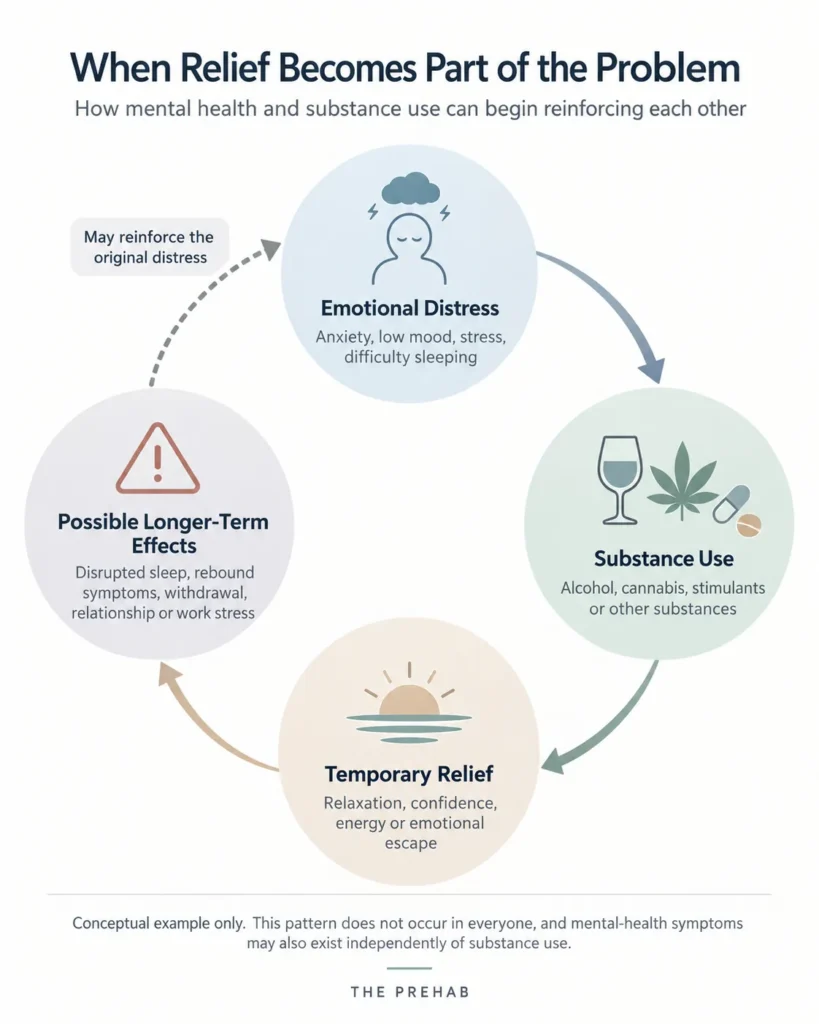
A coping strategy becomes more concerning when it starts to narrow the person’s choices. They may increasingly need alcohol to socialise, cannabis to sleep, or stimulants to feel productive. More may be needed to achieve the same effect, and the consequences of using can create additional emotional distress.
This is where mental health and substance use can begin feeding each other. A person may drink because they are anxious, sleep poorly after drinking, feel more anxious the following day, and return to alcohol because the anxiety is now harder to tolerate. Someone may use a stimulant to feel energetic and confident, then experience low mood, irritability or exhaustion as the effects wear off, making another period of use more tempting.
The important point is not that every substance inevitably causes a mental-health disorder. It is that repeated use can alter the context in which anxiety, low mood, sleep disturbance and emotional regulation are experienced. Over time, the substance someone relies on for relief may also intensify the distress that leads them to use it.
Which came first: anxiety, depression, or substance use?
Clinicians do ask which came first, and for good reason. If panic attacks were present years before someone began drinking heavily, that history matters. If low mood appeared only after a period of heavy stimulant use and improves during sustained abstinence, that matters too.
But human lives rarely divide neatly into “primary mental illness” on one side and “substance problem” on the other. A person may have a longstanding vulnerability to anxiety and discover that alcohol provides rapid short-term relief. Heavy drinking may then worsen sleep and increase anxiety between episodes. Relationship or work problems may add further stress, creating another reason to drink.
There can also be shared influences rather than a single cause. Genetic vulnerability, chronic stress, trauma, temperament, physical health, social environment and isolation can all matter. The question of what came first can therefore help build a timeline, but it should not force a complicated history into one explanation.
Can alcohol or drugs cause anxiety or depression?
Sometimes substance use can produce, amplify or closely resemble mental-health symptoms. In other cases, an independent mental-health condition is present as well. Distinguishing between the two can require careful assessment and, at times, observation over a period of greater stability.
Alcohol can feel calming while it is being consumed, yet heavy use and repeated withdrawal can increase anxiety. Poor sleep, irritability, low mood and anxiety can also occur as alcohol wears off or during withdrawal. In a person drinking heavily, these symptoms may initially be difficult to separate from an independent anxiety or depressive disorder.
Stimulants create a different pattern. During use, a person may feel energetic, confident or focused. During a crash or withdrawal, some people experience fatigue, disrupted sleep, low mood, reduced pleasure, irritability, anxiety or difficulty concentrating. If symptoms persist beyond the expected period of withdrawal, an underlying or additional mental-health condition may need to be considered.
Cannabis is more complicated than either the claim that it is harmless or the claim that it inevitably causes mental illness. Some people experience relaxation; others experience increased anxiety, panic, paranoia or disorientation. Cannabis use is associated with several mental-health difficulties. Research indicates a stronger association with psychotic disorders, including schizophrenia, among people who begin using at an earlier age or use more frequently. These population-level associations do not establish that cannabis caused a particular person’s condition.
Symptoms that occur during intoxication, rebound, withdrawal or periods of heavy use are still real. Calling them “just the drugs” can be dismissive. The clinical task is to understand their timing, severity and course, and whether they improve, persist or change as substance use changes.
When mental health is driving substance use
The opposite mistake is to assume that mental-health symptoms will disappear once substance use stops.
For some people, anxiety, depression, trauma-related symptoms, ADHD, sleep problems or other difficulties were present long before alcohol or drugs became significant. The substance may have become a way of managing something that had never been adequately understood or treated.
The term “self-medication” is often used to describe this, but it can oversimplify what is happening. A person may not consciously decide to medicate a psychiatric condition. They may simply discover through experience that a particular emotional state becomes easier to tolerate after drinking, smoking or using. Someone with social anxiety may gradually become convinced they cannot socialise without alcohol. Someone who relies on cannabis to switch off at night may become increasingly apprehensive about facing their thoughts without it.
If care focuses only on stopping substance use, the distress that contributed to it may remain unaddressed. Recognising why someone returns to a substance does not mean overlooking the harm associated with continued use. It means treatment is more likely to help when it addresses both the substance use and the reasons the person keeps returning to it.
What a good assessment is trying to understand
A useful assessment is not simply an exercise in deciding whether someone meets criteria for addiction, depression or anxiety. It tries to build a timeline and understand the relationship between the problems.
Important questions include when the emotional symptoms first appeared, when substance use became regular or heavy, what happens to anxiety, mood and sleep during periods of reduced use or abstinence, and whether there has ever been a sustained period without the substance. A clinician will also consider physical health, prescribed medication, other substances, relationships, trauma history, current stress, previous treatment and family history.
Risk assessment is equally important. Severe withdrawal, suicidality, psychosis, mania, aggression, blackouts, dangerous intoxication and medical instability require a different level of urgency from milder symptoms that can be explored safely in routine outpatient care.
Sometimes the picture is reasonably clear after the first assessment. Sometimes it is not. In complicated cases, diagnostic clarity can improve only after a period of stability and ongoing reassessment. That uncertainty is not a failure of assessment; it is often an accurate reflection of how intertwined the problems have become.
Do you have to stop using before your mental health can be treated?
There is no useful universal rule that mental-health treatment must wait until a person is completely abstinent.
With heavy alcohol use, for example, anxiety and depressive symptoms may improve substantially when drinking is reduced or stopped, and reassessing symptoms after a period of abstinence can help clarify what remains. But that does not mean significant depression, anxiety, trauma symptoms or other psychiatric problems should simply be ignored while someone is told to “get sober first.”
When both a substance use disorder and a mental-health disorder are present, current clinical guidance supports addressing both. Depending on the person, that may involve psychotherapy, psychiatric assessment, medication, addiction treatment, medical care, peer support, family work or a combination of these.
The sequence depends on risk and need. Someone at risk of severe alcohol withdrawal may need medically supported withdrawal before deeper psychological work. Suicidality, acute psychosis or mania may require urgent clinical assessment and a higher level of care, regardless of whether substance use is also present. Someone with less severe substance use and an established anxiety disorder may be able to work on both at the same time in an outpatient setting.
Important safety point: people who may be physically dependent on alcohol or benzodiazepines should not assume that abruptly stopping on their own is safe. Withdrawal can be medically serious and, in some circumstances, life-threatening. Medical advice is important when significant dependence or withdrawal risk is possible.
Finding the right level of help
Not everyone struggling with mental health and substance use needs residential treatment. Equally, a weekly therapy appointment is not sufficient for every situation.
The appropriate level of care depends on the substances involved, withdrawal risk, psychiatric symptoms, physical health, immediate safety, previous attempts to change, the home environment and the support available around the person.
For some people, the first useful step is a conversation with a therapist, doctor or addiction professional who can look at the whole picture rather than treating one symptom in isolation. Others may need structured outpatient treatment, psychiatric care, medically supervised withdrawal or residential support.
The purpose of assessment is not to persuade someone into the most intensive form of treatment. It is to understand enough of the situation to recommend the level of help that actually fits.
Clarity often comes after change has begun
People often feel they need to understand exactly why they are drinking or using before deciding what to do. Sometimes the opposite is true.
A period of change can reveal information that was impossible to see while the pattern was continuing. Sleep may improve. Anxiety may settle. Mood may lift. Or the person may discover that, even without the substance, a significant depression, anxiety disorder, trauma response or other difficulty remains and needs treatment in its own right.
Either outcome is useful information. The aim is not to decide whether someone’s distress is “real” or “caused by substances.” Distress is real regardless of its origin. The task is to understand the relationship well enough to respond to it properly.
Sometimes substance use is an attempt to cope with a mental-health problem. Sometimes it creates or amplifies symptoms that look like one. Very often, the two begin feeding each other until separating cause from consequence becomes less important than interrupting the cycle.
You do not always need a perfect label before taking the next sensible step. Sometimes the clearer picture appears only after you begin.
Recovery Can’t Be Outsourced. It Has to Be Lived.
Further Reading
- National Institute on Alcohol Abuse and Alcoholism (NIAAA): Mental Health Issues: Alcohol Use Disorder and Common Co-occurring Conditions
- Substance Abuse and Mental Health Services Administration (SAMHSA): Screening and Treatment of Co-Occurring Disorders
- Centers for Disease Control and Prevention (CDC): Cannabis and Mental Health
- American Society of Addiction Medicine (ASAM): Stimulant Use Disorder Guideline
- American Society of Addiction Medicine (ASAM): Benzodiazepine Tapering Guideline
About the author
Dr. Saji Joseph, PhD is Founder & Clinical Architect of The Prehab. His clinical work focuses on addiction, trauma, psychotherapy and recovery-oriented care.