Treatment can help. Therapists can guide. Families can support. Medication can stabilise. Rehab can create the conditions for change. But eventually, recovery has to become something a person does with their own life.
Saji Joseph, PhD • The Prehab
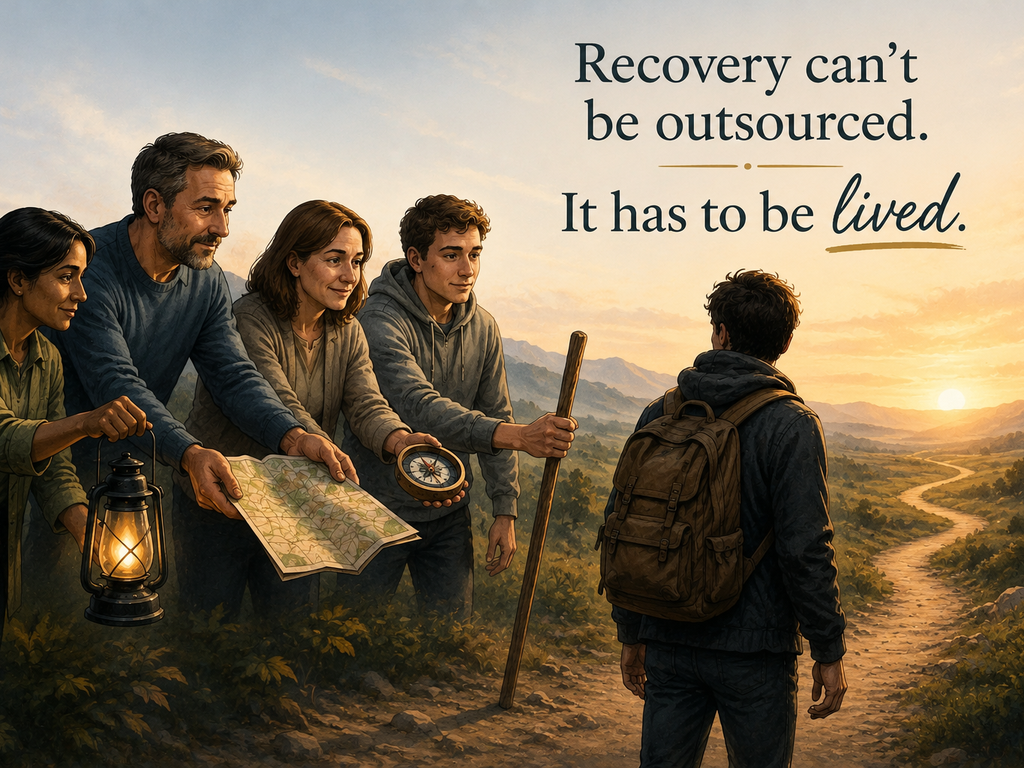
In conversations about addiction treatment, clients often say, quite sincerely, that they understand they have to do the work themselves. Families usually express the same understanding in slightly different language: the rehabilitation centre can only do so much; ultimately, it depends on what the person does with the opportunity.
Both statements are usually true and genuinely meant. Yet, as discussions about treatment continue, another expectation can sometimes be heard beneath them. There may still be a hope that somewhere there is a sufficiently good rehabilitation centre, therapist, programme, medication, trauma intervention or therapeutic method that will finally make the change happen.
This does not necessarily reflect naivety or unwillingness. Addiction can leave people exhausted by repeated attempts to control their behaviour, and families may have spent years trying to manage crises they no longer know how to manage. In that position, it is entirely understandable to want competent professionals to take over. We routinely seek expertise when a problem has exceeded our own capacity to deal with it.
The difficulty is that addiction places a limit on what expertise can provide. Treatment can be medically necessary, psychologically important and, in some circumstances, life-saving. It can manage dangerous withdrawal, stabilise psychiatric symptoms, identify problems that have been missed, interrupt destructive patterns, provide structure, teach practical skills and create enough distance from chaos for a person to begin thinking and behaving differently. What it cannot do is undertake recovery on somebody else’s behalf.
Care can be provided. Recovery cannot.
The expectation that the right treatment will fix the problem
There is nothing unreasonable about wanting the best available treatment. Where somebody receives care can matter considerably. Clinical competence matters, as do medical safety, appropriate diagnosis, therapeutic relationships, treatment intensity and continuity of care. Some people need residential treatment, while others may be better served by specialist outpatient therapy, medication, community-based support or a combination of interventions. Treatment should be matched as carefully as possible to the person’s needs rather than selected simply because one option appears more intensive or impressive.
The problem arises when the search for appropriate care becomes, often without anybody explicitly acknowledging it, a search for a service that can produce recovery. Families may ask which centre has the best success rate, whether 90 days would be better than 30, whether treatment overseas would create more distance from the problem, whether a particular programme specialises in trauma, or whether a previous attempt failed because the rehabilitation centre was not good enough. These are not inherently inappropriate questions. What matters is the expectation that sits behind them.
There is a meaningful difference between asking, “Where can this person receive good treatment?” and asking, “Where can we send this person so that recovery finally happens to them?” The first question concerns the quality and appropriateness of care. The second gives treatment a role it cannot realistically fulfil.
A similar tension can exist within the person struggling with addiction. Someone may understand that change is necessary while continuing to construct explanations for why the situation is not yet serious enough, why a different set of circumstances would solve the problem, or why another treatment experience might finally remove the need to make difficult changes themselves. The Truths About Addiction examines this wider pattern of recognising aspects of the problem while remaining partially protected from their implications.
The wish for treatment to remove uncertainty, distress and responsibility is understandable. The difficulty begins when treatment providers, families or clinicians reinforce the idea that this is what treatment can do.
The long history of the “special cure”
The hope that somebody has discovered a uniquely effective answer to addiction is not new. During the late nineteenth century, the American physician Leslie Keeley became widely known for his proprietary “Gold Cure” for alcohol and drug problems. Keeley institutes expanded rapidly, and large numbers of people entered treatment centred partly around a secret medical formulation that attracted enthusiastic testimonials as well as substantial criticism from the medical profession.[1]
Modern addiction treatment should not be equated with nineteenth-century cure movements. Contemporary care is supported by far better evidence, more rigorous clinical standards and a much broader understanding of addiction. We now have effective medications for some substance use disorders, evidence-based psychotherapies, safer approaches to withdrawal management, psychiatric treatment, trauma-informed interventions and a more developed appreciation of the biological, psychological and social factors that influence both addiction and recovery.
Nevertheless, the underlying human appeal of the “special cure” remains relevant. When addiction has become sufficiently frightening, certainty becomes attractive. A person or family may understandably want to believe that somewhere there is a programme, method or specialist capable of achieving what previous efforts have not.
Treatment organisations also operate in a competitive environment and need to explain what distinguishes their services. There is nothing inherently unethical about describing a particular clinical model, specialist expertise or treatment environment. The problem arises when legitimate differences between programmes are presented in a way that implies a unique capacity to produce recovery. Claims about proprietary approaches, exceptional outcomes or transformative methods can easily shift the focus from what treatment offers to what treatment supposedly guarantees.
Professional ethical standards in addiction treatment recognise the vulnerability created by this kind of marketing. The National Association of Addiction Treatment Providers, for example, prohibits false, deceptive or misleading marketing and requires members to represent their services, credentials and levels of care accurately.[2] Ethical treatment providers should be able to describe what they offer with confidence while remaining honest about the limits of what any programme can accomplish.
There is no need for treatment to promise something extraordinary in order to have value. Providing competent assessment, clinically appropriate intervention, medical and psychological safety, dignity, continuity of care and honesty about limitations is already a substantial commitment.
What research tells us about treatment
The argument that recovery cannot be outsourced should not be mistaken for an argument that treatment does not matter. Research clearly supports the effectiveness of psychosocial and medical interventions for substance use disorders, and certain treatments may be particularly useful for particular populations, substances or outcomes. The evidence does, however, make it difficult to sustain the idea that one treatment philosophy possesses a universally decisive ingredient.
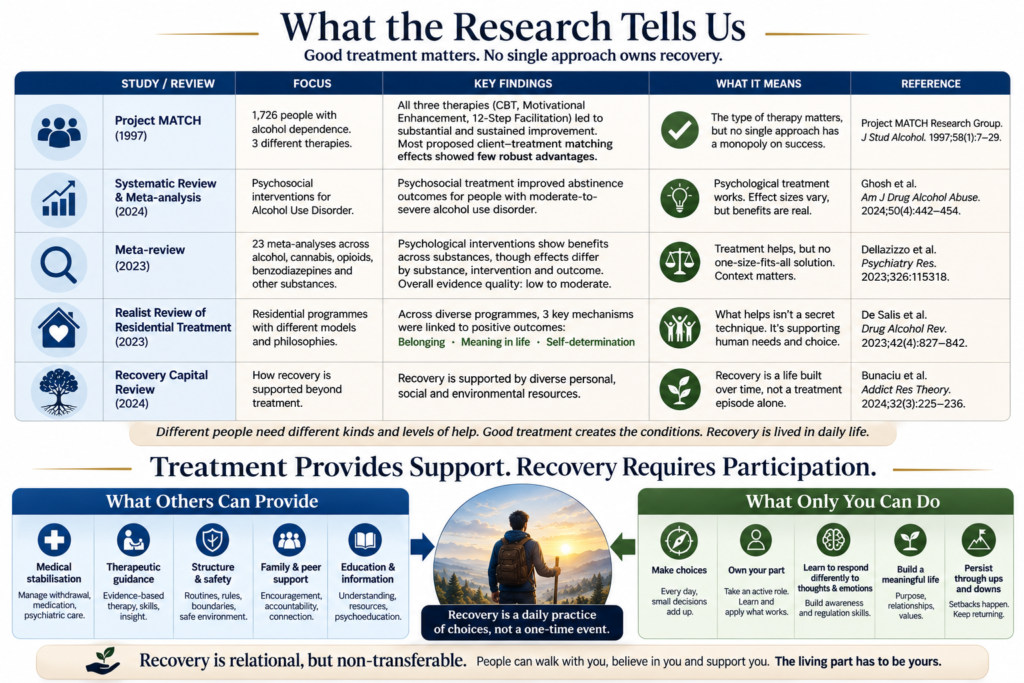
Project MATCH remains one of the best-known examples. The study involved 1,726 people with alcohol dependence who were assigned to Cognitive Behavioural Therapy, Motivational Enhancement Therapy or Twelve-Step Facilitation. Participants in all three conditions showed substantial and sustained improvement. Most of the proposed client–treatment matching effects showed few robust advantages, meaning that carefully matching particular types of clients to particular therapies produced much less differential benefit than originally anticipated.[3]
Project MATCH has sometimes been interpreted too broadly as evidence that the type of therapy does not matter. That is not what the study established, and subsequent research gives no basis for such a conclusion. A 2024 systematic review and meta-analysis conducted as part of work updating evidence relevant to WHO guidance found that psychosocial interventions improved abstinence outcomes for people with moderate-to-severe alcohol use disorder compared with treatment as usual.[4] A broader 2023 meta-review of 23 previous meta-analyses covering alcohol, cannabis, stimulants, opioids and benzodiazepines also found benefits from psychological interventions, although effects varied according to the substance, treatment and outcome being examined, and the certainty of the evidence was generally low to moderate.[5]
The appropriate conclusion is therefore not that all treatments are equivalent. Treatment matters, and both the method and the quality of clinical delivery can matter. What the evidence does not support is the idea that any one programme, therapeutic school or treatment centre has ownership of the process by which recovery occurs.
Good treatment matters enormously. No treatment owns recovery.
Research on residential treatment adds another useful perspective. A 2023 realist review examined residential programmes that differed considerably in philosophy and clinical approach. In developing overarching theories to explain how beneficial change may occur across different residential settings, the authors identified belonging, meaning in life and self-determination as important recurring mechanisms.[6]
These findings do not establish that such factors explain every successful treatment outcome, but they are relevant to the distinction between treatment and recovery. A programme may create opportunities for connection, help a person rediscover meaning, or strengthen their capacity to participate in decisions about their own life. None of these processes can remain confined to the treatment environment if recovery is to continue after discharge. The value of the programme lies partly in what the person is able to carry forward from it.
Treatment is part of recovery, but it is not the same as recovery
Contemporary definitions of recovery increasingly recognise that treatment and recovery overlap without being interchangeable. The US National Institute on Alcohol Abuse and Alcoholism defines recovery from alcohol use disorder as a process and outcome involving remission from AUD and cessation of heavy drinking, with recovery often accompanied by broader improvements in physical and mental health, social functioning, quality of life and wellbeing.[7]
SAMHSA similarly describes recovery as a process of change through which people improve health and wellness, live increasingly self-directed lives and work towards their potential. Its framework recognises multiple pathways to recovery, including professional treatment, medication, peer support, family, community and self-care.[8]
These definitions matter because they locate recovery within a person’s life rather than within a particular service. Someone can complete a course of treatment without having integrated much of what they learned into everyday functioning. Conversely, some people develop substantial and sustained recovery with relatively little formal treatment. People with greater severity, psychiatric complexity, medical risk or unstable social circumstances may require extensive treatment and support over much longer periods.
The implication is not that less treatment is preferable. It is that the type and intensity of help should correspond to clinical need. Not Everyone Needs the Same Kind of Help explores this distinction in greater depth.
Evidence from people in recovery themselves also reinforces this broader understanding. In a study involving 9,341 participants who identified as being in recovery from substance use problems, widely shared elements included personal growth and development, honesty with oneself, taking responsibility for what can be changed, and learning to respond to life in a more balanced way.[9] These findings describe recovery in terms of ongoing ways of functioning rather than the receipt of a particular treatment service.
What happens when treatment structure is removed?
Residential treatment can temporarily provide a high degree of external structure. The day is organised, access to substances may be restricted, therapy and groups occur at scheduled times, meals and sleep may become more regular, and professionals or peers may notice changes in behaviour that would go unseen in ordinary life. There may also be medical support, exercise, accountability, community and distance from environments closely associated with substance use.
For someone whose life has become chaotic, this degree of structure can be profoundly therapeutic. It can reduce immediate risk and create conditions in which learning, reflection and behavioural change become more possible. At the same time, functioning well within a structured environment does not necessarily tell us how well a person will function once that structure has been removed.
The clinically important question is therefore not only how somebody behaves while recovery is organised around them, but what continues when they return to ordinary life. After discharge there may be no counsellor present when resentment builds, no programme rule preventing an impulsive decision, no scheduled group at the end of the afternoon and nobody immediately noticing a gradual return to old patterns. Treatment has to prepare for this transition rather than simply demonstrate that a person can function successfully inside the treatment setting.
Continuing-care research supports the importance of what happens after an intensive treatment episode. McKay’s review found that continuing care can improve substance-use outcomes, although the magnitude of benefit varies, and longer interventions that actively engage people over time may be particularly useful for some individuals at higher risk of relapse.[10]
Research on recovery capital approaches the same issue from a broader perspective. A 2024 systematic review identified 69 studies, 10 recovery-capital questionnaires and 41 distinct constructs used to describe the personal, social and environmental resources associated with recovery.[11] These included resources relating to relationships, psychological strengths, community, stability, opportunity and other aspects of life that can support change.
Treatment can help people develop or reconnect with these resources, but it cannot remain a permanent substitute for them. One of the tasks of effective care is therefore to help a person build a life in which recovery is supported outside the treatment environment.
Recovery is lived in ordinary situations
Much of the work that sustains recovery is not dramatic and often occurs without any clinician or family member present. It may involve recognising anger without immediately acting through an old coping behaviour, noticing increasing isolation and asking for help early, refusing an invitation that carries obvious risk, leaving a situation before judgement deteriorates, or acknowledging that things are beginning to go wrong before they have developed into a crisis.
Other changes are even less visible. Recovery may involve improving sleep, managing money more consistently, learning to tolerate boredom, repairing relationships, recognising resentment, responding differently to shame, ending relationships that repeatedly destabilise progress, or discovering ways of celebrating, resting and managing stress that no longer depend on intoxication or other compulsive behaviour.
These are ordinary decisions, but over time they represent a significant shift in how somebody manages internal states and external demands. Treatment can help a person understand these patterns and practise alternative responses, but eventually those responses have to occur in environments where treatment is not immediately available.
Insight can help considerably, but insight by itself is rarely sufficient. People often recognise that something is wrong long before they are able or willing to act on what they know. Knowing Something Is Wrong — and Still Waiting examines that gap between recognition and action.
Recovery involves gradually reducing that gap. A person becomes more able to recognise what is happening, understand the likely consequences of continuing along the same path and respond earlier. This does not happen perfectly or permanently, but the repeated capacity to respond differently is part of what allows recovery to become embedded in everyday life.
Families encounter the same boundary
Families often carry far more of the treatment process than they initially realise. They research rehabilitation centres, arrange appointments, pay for treatment, speak with clinicians, monitor medication, manage crises and remain alert for signs of deterioration. These actions are usually motivated by concern, fear and the understandable wish to keep someone safe.
Some forms of practical involvement may be necessary, particularly when risk is high or the person is temporarily unable to organise important aspects of their own care. The difficulty comes when the family gradually takes responsibility for parts of recovery that ultimately need to return to the person themselves.
A parent can arrange an assessment, but cannot make somebody speak honestly during it. A partner can establish a boundary, but cannot make the other person understand or accept why the boundary became necessary. A family can make treatment available, encourage attendance and remain involved with clinicians, but cannot manufacture motivation or ensure that what is learned in treatment is used afterwards.
This does not mean that families should withdraw or adopt a detached position. Recovery is strongly influenced by relationships, and supportive families can be extremely important. The distinction lies between contributing to conditions that support change and repeatedly assuming responsibility for the change itself. How Families Can Support Without Enabling examines this balance in more detail.
Recovery is therefore deeply relational without being transferable. Other people can provide safety, encouragement, professional care, boundaries, accountability and connection, but they cannot take over the process by which a person learns to live differently.
What ethical treatment can reasonably promise
The addiction-treatment field may benefit from placing less emphasis on promises of transformation and more emphasis on the quality and integrity of care. A provider should be able to explain how assessment is conducted, what clinical competencies are available, how medical and psychiatric risks are managed, what evidence informs treatment, how families are involved, how discharge is planned and what continuing-care arrangements are offered.
Treatment services should also be clear about the limits of their expertise. There are situations in which a programme is not the appropriate service for a particular person, and recognising that fact is an indication of clinical integrity rather than inadequacy. Referral elsewhere may be the most responsible intervention.
Good treatment should help people understand the nature of their difficulties, develop skills for managing them, address relevant medical, psychiatric and psychological factors, strengthen relationships and social supports where possible, and prepare realistically for life beyond the treatment environment. It should also avoid suggesting that impressive facilities, specialised terminology or a distinctive programme model can substitute for the person’s ongoing participation.
The philosophy behind The Prehab’s counselling and recovery-support pathways begins from the same principle: treatment should be selected according to the needs of the person rather than fitting the person into a predetermined treatment pathway.
An ethical treatment provider can reasonably promise to take its responsibility for care seriously, to provide treatment within its competence, and to create the best possible conditions for meaningful change. It cannot promise to live that change for the person receiving care.
Recovery has to become part of life
The transition from treatment-supported change to lived recovery is often seen in situations that appear unremarkable from the outside. A person may encounter an opportunity to return to an old behaviour at a time when nobody is monitoring them and no immediate consequence would follow. On a previous occasion they might not have noticed the sequence developing until it was already well advanced. This time they recognise it earlier and respond differently.
That change does not mean recovery has become effortless or that the person has achieved complete self-control. Nor does it mean that professional treatment, medication, mutual-aid groups, family involvement or other forms of support are no longer needed. Long-term recovery may continue to depend on some or all of these resources, and the amount of support required can increase again during difficult periods.
Living recovery does not mean becoming independent of other people. It means becoming an active participant in the process of change and increasingly applying what has been learned in the circumstances of ordinary life. Over time, recovery becomes visible in how somebody responds to distress, relationships, responsibility, pleasure, disappointment, loneliness, risk and the need for help.
Treatment can help. Therapists can guide. Families can support. Medication can stabilise. Rehabilitation can create the conditions in which significant change becomes possible. None of these should be minimised, and none should be confused with the recovery itself.
Care can be provided. Recovery cannot.
Recovery can’t be outsourced. It has to be lived.
References
1. Hickman, T. A. (2021). “We Belt the World”: Dr. Leslie E. Keeley’s “Gold Cure” and the Medicalization of Addiction in 1890s London. Bulletin of the History of Medicine, 95(2), 198–226. doi:10.1353/bhm.2021.0030
2. National Association of Addiction Treatment Providers. Code of Ethics. Section V: Marketing. NAATP Code of Ethics
3. Project MATCH Research Group. (1997). Matching Alcoholism Treatments to Client Heterogeneity: Project MATCH posttreatment drinking outcomes. Journal of Studies on Alcohol, 58(1), 7–29. doi:10.15288/jsa.1997.58.7
4. Ghosh, A., Morgan, N., Calvey, T., Scheibein, F., Angelakis, I., Panagioti, M., Ferri, M., & Krupchanka, D. (2024). Effectiveness of psychosocial interventions for alcohol use disorder: A systematic review and meta-analysis update. The American Journal of Drug and Alcohol Abuse, 50(4), 442–454. doi:10.1080/00952990.2024.2350056
5. Dellazizzo, L., Potvin, S., Giguère, S., Landry, C., Léveillé, N., & Dumais, A. (2023). Meta-review on the efficacy of psychological therapies for the treatment of substance use disorders. Psychiatry Research, 326, 115318. doi:10.1016/j.psychres.2023.115318
6. De Salis, H. F., Martin, R., Mansoor, Z., Newton-Howes, G., & Bell, E. (2023). A realist review of residential treatment for adults with substance use disorder. Drug and Alcohol Review, 42(4), 827–842. doi:10.1111/dar.13615
7. Hagman, B. T., Falk, D., Litten, R., & Koob, G. F. (2022). Defining Recovery From Alcohol Use Disorder: Development of an NIAAA Research Definition. American Journal of Psychiatry, 179(11), 807–813. doi:10.1176/appi.ajp.21090963
8. Substance Abuse and Mental Health Services Administration. Recovery and Recovery Support. SAMHSA Recovery and Recovery Support
9. Zemore, S. E., Ziemer, K. L., Gilbert, P. A., Karno, M. P., & Kaskutas, L. A. (2023). Understanding the Shared Meaning of Recovery From Substance Use Disorders: New Findings From the What Is Recovery? Study. Substance Abuse: Research and Treatment, 17, 11782218231199372. doi:10.1177/11782218231199372
10. McKay, J. R. (2021). Impact of Continuing Care on Recovery From Substance Use Disorder. Alcohol Research: Current Reviews, 41(1), 01. doi:10.35946/arcr.v41.1.01
11. Bunaciu, A., Bliuc, A.-M., Best, D., Hennessy, E. A., Belanger, M. J., & Benwell, C. S. Y. (2024). Measuring recovery capital for people recovering from alcohol and drug addiction: A systematic review. Addiction Research & Theory, 32(3), 225–236. doi:10.1080/16066359.2023.2245323
This article is intended for general educational purposes and does not determine which type or level of treatment is appropriate for any individual. Addiction treatment should be guided by clinical circumstances, safety, individual needs and appropriate professional assessment.