

A PREHAB MIRROR ARTICLE
Why concerns about addiction can feel like criticism – and how to examine what others may be noticing without shame or pressure
For anyone questioning their relationship with alcohol, drugs or a potentially addictive behaviour – and for the people who may be seeing the pattern first.
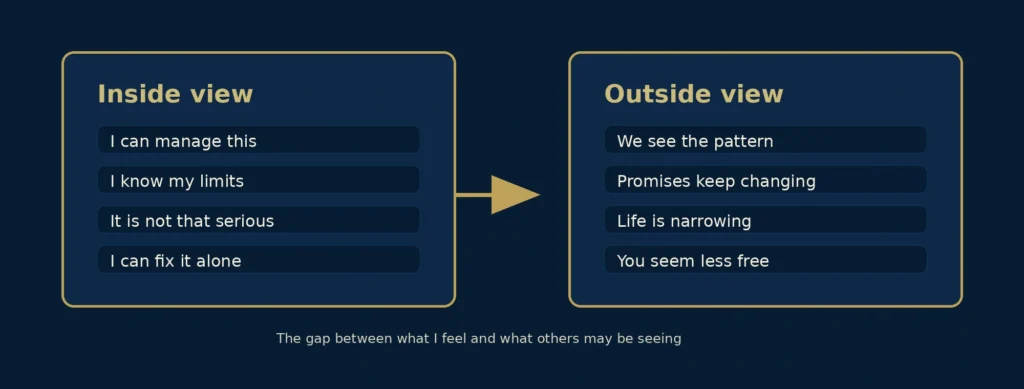
When concern keeps returning, the pattern deserves a closer look.
Recovery cannot be outsourced. But it can begin with one honest look.
When Loved Ones See the Problem Before You Do
Why concerns about addiction can feel like criticism – and how to examine what others may be noticing without shame or pressure
Often, the first sign of a developing problem is not a crisis but a disagreement about what has been happening. You remember one difficult evening. Your partner remembers the fourth promise that did not hold. You remember why each occasion was different. They remember how often the same conversation has returned.
That difference in viewpoint helps explain why concern sometimes arrives from other people before it becomes clear to the person directly involved. A partner notices the repeated promises. A friend sees the change in mood. A colleague quietly compensates. A child senses that someone is less present. From the inside, these may feel like separate incidents. From the outside, they may already form a direction.
Hearing that concern can feel unfair. You may feel judged, misunderstood, watched or controlled. You may also be right about some of that: loved ones can panic, communicate badly, exaggerate, become intrusive or confuse their fear with certainty. Their concern is not automatically a diagnosis, and it does not require you to accept every conclusion they reach.
CENTRAL IDEA
Another person’s concern cannot, by itself, tell you whether you have an addiction. But when the concern keeps returning, it deserves to be examined rather than argued away.
1. Loved ones may see a pattern where you see separate incidents
When you live inside a behaviour, you also live inside its context. You know about the stressful week, the argument, the celebration, the grief, the sleepless night or the reason this occasion felt different. Those explanations may be completely true. But people around you often see something else: the same explanation changing while the behaviour keeps returning.
They may notice that promises to cut down are repeatedly revised, that money or time is disappearing, that questions produce defensiveness, or that life is gradually being organised around access, use, relief, secrecy or recovery. They are not necessarily seeing your inner world more accurately than you are. They may simply have a clearer view of repetition over time.
MIRROR QUESTION
What pattern might they be seeing that I am still experiencing as separate events?
2. Concern can feel like criticism – even when it contains care
Concern rarely arrives in perfect language. It may come out as anger, accusation, pleading, monitoring or another exhausted conversation. Once the message feels hostile, it becomes natural to defend yourself against the way it was delivered rather than examine what prompted it.
Sometimes the delivery is the main problem. A partner may speak harshly, monitor too closely or make assumptions. Even so, it can help to separate what was said from how it was said. Imagine the same concern offered calmly and respectfully. Would any part of it still be hard to hear?
3. Explanations may be true and still incomplete
Self-protection is not always deliberate dishonesty. The mind naturally tries to preserve identity, dignity, relationships, work and the belief that life remains manageable. It may say: I am under pressure. I still function. Other people do more than I do. I can stop when I decide. My partner worries too much.
Any of those statements may contain truth. Once you have explained the incident, ask what the explanation still leaves unanswered. Does stress account for the whole pattern? Does continued functioning explain the secrecy or the broken limits? An explanation can help you understand what happened; it can also end the enquiry before you have looked at everything.
4. Functioning does not settle the question
From your point of view, continuing to work, parent, earn, exercise and meet responsibilities may be the strongest evidence that the concern is exaggerated. The people around you may be noticing a different cost: the energy spent recovering, the plans built around access, the conversations avoided, or the emotional presence that has gradually thinned.
Both views may contain truth. You may still be dependable in many parts of life while one area is demanding more accommodation than it used to. Instead of asking only whether you are still functioning, notice what everyone – including you – has started doing to keep that functioning intact.
MIRROR QUESTION
What has become harder to maintain – and who has quietly helped me maintain it?
5. Intentions and promises are not the same as evidence
When people question a pattern, it is natural to answer with intentions: I will cut down, take a month off or make a firmer rule. Those intentions may be sincere, and loved ones may even feel reassured by them. What matters next is whether everyday behaviour begins to change.
Look back rather than forward. Which limits actually held? What happened after a period of abstinence? When a rule was broken, was it strengthened – or quietly rewritten? A promise matters most when it leaves evidence in what happens next.
MIRROR QUESTION
Is my sense of control supported by my intentions – or by what repeatedly happens when I try?
6. Choice can remain while becoming progressively narrower
The language of being ‘out of control’ can feel inaccurate because no one is physically forcing the behaviour. You may still experience yourself as choosing. Addiction, however, does not need to remove choice completely in order to influence it. With repetition, cues, craving, relief, habit and stress can give one option increasing motivational weight.
Notice what happens when the usual option is unavailable. Do you feel disappointed and move on, or does your attention stay fixed on finding another way? The restlessness, bargaining or preoccupation that follows can reveal more than the statement I chose it. Choice may still be present, but it may be operating within a narrower set of possibilities.
MIRROR QUESTION
What happens inside me when the familiar option is unavailable?
7. The feeling may be real; the old solution may no longer be helping
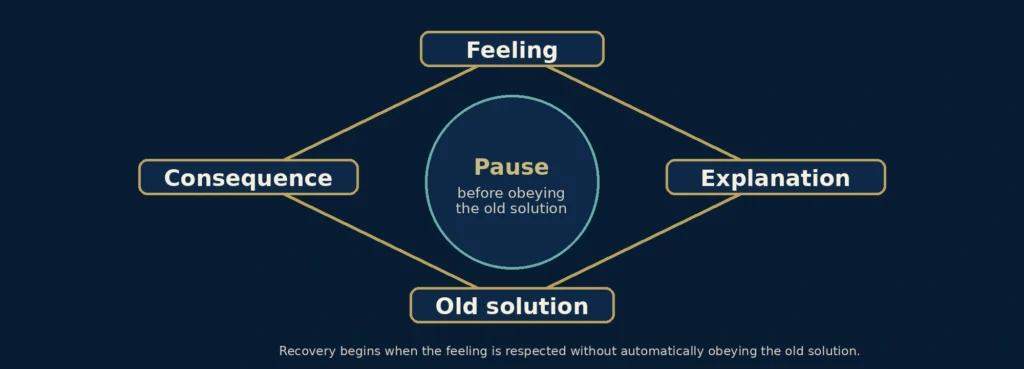
Alcohol, drugs, gambling, gaming or another compulsive behaviour may have started because it worked in some important way. It brought relief, confidence, connection, excitement, numbness or escape. Recognising its consequences does not erase the need it has been serving.
The need deserves to be understood: perhaps you are overwhelmed, rejected, lonely or unable to switch off. Understanding that need is different from assuming the familiar response is still the best way to meet it. Even a brief pause between the feeling and the old solution can create room to ask what else might help.
8. Loved ones are not always right – but repeated concern still matters
It is important not to romanticise family concern. Some relationships are controlling, unsafe or chronically conflictual. One person’s accusation should not be treated as clinical proof. A fair examination looks for observable information rather than labels: What exactly has changed? How often? What promises were made? What consequences have repeated?
Concern becomes harder to dismiss when it comes independently from more than one person, when the same issue returns across different situations, or when behaviour repeatedly contradicts intention. Listening does not mean surrendering your judgement. It means hearing the specifics before deciding what they add to the picture.
BALANCED PRINCIPLE
Ask for examples. Listen for what has repeated. Decide what their concern means after you have heard the specifics.
9. Shame can turn concern into an attack
People do not always avoid help because they do not care. Often, they are protecting themselves from shame: shame about what happened, what was hidden, what was promised, or what asking for help might seem to say about them. When shame is activated, concern can sound like humiliation and curiosity can feel dangerous.
A problem does not become your whole identity simply because you name it. You can be a loving, capable person and still need help with one part of your life. Looking honestly is not an act of self-condemnation; it is a way of no longer carrying the pattern alone.
10. You do not need rock bottom to look honestly
The idea that someone must lose everything before change becomes legitimate is one of the most damaging myths surrounding addiction. You are allowed to investigate a problem before its consequences become severe. Repeated concern, a promise that did not hold, or the sense that life is narrowing can justify an honest assessment.
You do not need to decide today whether you have an addiction or what treatment you might need. A useful first step is simply to describe what has been happening, hear the examples others are giving you, and compare your intentions with what has actually occurred. That conversation may clarify whether you need no further action, some changes or professional support.
A self-reflection exercise
The gap between my view and their view
Answer slowly and concretely. Record what was actually said or observed before explaining why it happened. The purpose is not to agree with anyone automatically. It is to see the full picture before deciding what it means.
| Reflection prompt | What to examine |
| What are the people close to me actually worried about? | Write their specific observations, not only how you felt when they raised them. |
| What do I usually do when the subject comes up? | Do I explain, minimise, attack, withdraw, promise, joke, intellectualise or change the subject? |
| Is the concern about one incident or a repeating pattern? | Look across time. What keeps returning despite different circumstances or explanations? |
| What have I promised myself before? | Which rules, limits or decisions held? Which were revised, postponed or broken? |
| What evidence supports my view? | Include functioning, periods of control and occasions when concern may genuinely have been exaggerated. |
| What evidence supports their view? | Include changes in trust, health, mood, money, presence, secrecy or repeated consequences. |
| What would I admit if I knew I would not be judged? | Notice the answer that appears before you begin explaining it. |
When to consider professional support
A confidential conversation or professional assessment may be worth considering if:
- people close to you repeatedly express similar concerns
- you have tried to cut down or stop but repeatedly return to the behaviour
- your rules or limits keep changing after they are broken
- you hide, minimise or edit important parts of what is happening
- trust, health, sleep, work, parenting, finances or emotional stability are being affected
- the behaviour has become one of your main ways of managing distress
- part of you is worried even while another part keeps arguing that everything is manageable
CLINICAL REMINDER
Seeking support does not mean that other people have won an argument. It means you are willing to understand the situation with more information and less pressure.
Final reflection
You do not have to accept someone else’s label. You might begin with a smaller acknowledgement: I can understand why they are worried, and I want to find out whether I should be worried too.
The people who love you may be frightened, imperfect and unsure how to help. Some may communicate badly; others may get parts of the situation wrong. Even so, their observations can add something that is difficult to see from inside your own experience. You can listen without surrendering your judgement.
FINAL MIRROR QUESTION
What if they are seeing something I need to understand?
Recovery cannot be outsourced. But it can begin with one honest look.
Clinical and safety note
This article is a psychoeducational and self-reflection resource. It cannot diagnose or exclude a substance use disorder, behavioural addiction or other mental health condition, and it does not replace individualised professional assessment.
Do not assume that abruptly stopping alcohol or another substance is always safe. Alcohol withdrawal can be life-threatening after prolonged heavy drinking, and withdrawal from some drugs or prescribed medicines may also require medically informed planning. If physical dependence or withdrawal risk is possible, seek appropriate medical advice before stopping suddenly.
Selected clinical grounding
1. American Society of Addiction Medicine (ASAM): Definition of Addiction
2. National Institute on Drug Abuse (NIDA): Drug Misuse and Addiction
3. National Institute on Alcohol Abuse and Alcoholism (NIAAA): Understanding Alcohol Use Disorder
4. World Health Organization (WHO): Gaming Disorder
5. World Health Organization (WHO): Gambling
Editorial distinction
Established evidence: Addiction can involve compulsive substance use or behaviour despite harm, and substance addiction is associated with changes in systems involved in reward, stress, learning and self-control. Alcohol withdrawal can be medically dangerous in some circumstances.
Clinical interpretation: Loved ones may sometimes recognise a repeating pattern before the person involved fully integrates it. This is not universally true and should be treated as information to examine, not proof of diagnosis.
The Prehab perspective: Honest self-observation is more likely when people are treated with dignity and the facts are not softened. Shame can obstruct insight; reassurance that dismisses every concern can do the same.